Rethinking how we assess impact
Cranfield Trust volunteer Phil Murray examines what a genuinely useful impact tool actually looks like.

That’s a good thing. But here’s the risk: tick-box compliance with the SORP’s fairly modest requirements could give some charities a false sense of security, nudging them away from the kind of rich, real-world appraisal of impact that actually makes a difference. Meeting the SORP is the floor, not the ceiling.
So what does a genuinely useful impact assessment look like? In my experience as a Cranfield Trust volunteer, it starts not with a spreadsheet but with a conversation.
Rather than beginning with a list of what the chief executive and trustees think is important, my preferred approach is to bring representatives of four key stakeholder groups together, in person or on a call, and simply ask them what matters. Those four groups are:
• Funders - the oxygen without which charities simply couldn’t breathe. As funders become more sophisticated, they want objective evidence of real-world difference, not just heartstring-tugging stories.
• Workers - everyone who takes action to pursue the charity’s aims: volunteers, staff, freelancers, partners and leaders. What unites them isn’t how they’re paid, but the fact that they inject their personal energy into the cause. Nobody knows better what it actually takes to make impact happen on the ground.
• Clients - the people and organisations who channel the charity’s work to end beneficiaries: schools, local authorities, doctors and more. They tend to have a sharp professional view of the need being met, and, crucially, how the charity stacks up against other options.
• Beneficiaries - the people whose lives are to be changed. Their perspective varies enormously. Some are deeply aware and grateful for the support they’ve received; others may not realise the significance of what the charity is doing, even when society as a whole does.
Whenever I've run participative sessions with charities, a common pattern emerges: a pyramid-shaped value framework, not unlike a Theory of Change, that traces the line from specific activities and inputs all the way through to the long-term outcomes that address a real societal problem.
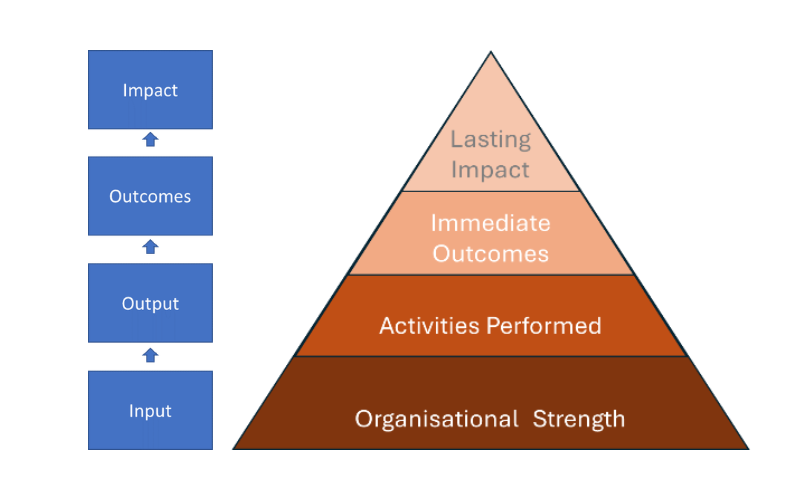
The labels on each layer of the pyramid will vary from charity to charity, but they work as “umbrella factors”: stable, overarching themes that hold firm over time, with more detailed measures underneath that can shift as priorities evolve. It’s a framework that gives you continuity without rigidity.
One charity I worked with relabelled their “Organisation Strength” layer as “Resilience”, because both funders and clients kept coming back to adaptability as the thing that set the charity apart. Under that heading, they tracked: average months of pledged funding, volunteer hour growth, staff and volunteer engagement, and a knowledge article count. Simple, purposeful, and directly connected to what stakeholders said they valued.
The side benefits of this process can be remarkable too. After one session, a funder rang up a few days later to say she’d heard enough to recommend bypassing the usual three-year funding review entirely. She’d seen what the charity was doing and she believed in it.
Here’s a trap many charities fall into: listing volume and calling it impact. “We served fifty thousand meals.” Great- but what difference did it make? A stronger framework captures quality and purpose-matching alongside the numbers. Some approaches that work well:
• Client testimonials and case studies - still powerful for emotional resonance, and essential for telling human stories. But for more sophisticated funders and commissioners, they need to be backed up by data.
• Brand recognition sampling - surveys that check whether the charity’s bigger goals are actually being felt. If your mission is “empowerment”, are the people you support genuinely feeling empowered? It’s worth asking.
• Beneficiary engagement studies - more sophisticated techniques that link easier-to-measure immediate outcomes with the harder-to-prove long-term impact. For instance: if “being listened to” turns out to be the feedback that best predicts future recovery, you’ve just found something worth prioritising.
Building the framework is only the beginning. What really determines whether impact management succeeds is how consistently it shows up in leadership and communication. Every annual report, funding bid, social media post and trustee update is an opportunity - and a test. Does this piece of communication say something about everything our framework says matters?
If the answer is no, funders, workers, clients and beneficiaries will start to wonder whether you really mean it. And in the charity sector, trust is everything.
From periods starting on or after 1 January 2026, all charities must include in their trustee report a summary of main achievements, addressing:
• In what way has the charity’s work made a difference to its beneficiaries?
• Has the charity’s work provided any wider benefits to society as a whole?
Medium to larger charities must also explain the long-term effect of their activities on individual beneficiaries and society. A stakeholder-led framework goes well beyond these requirements, and produces something far more useful.
Our thanks to Phil Murray, a Cranfield Trust volunteer with experience in impact assessment and evaluation across the charity sector, for writing this article.


